
Foreword
The monthly update from Trajectory: September 2025


Seasonal adjustment
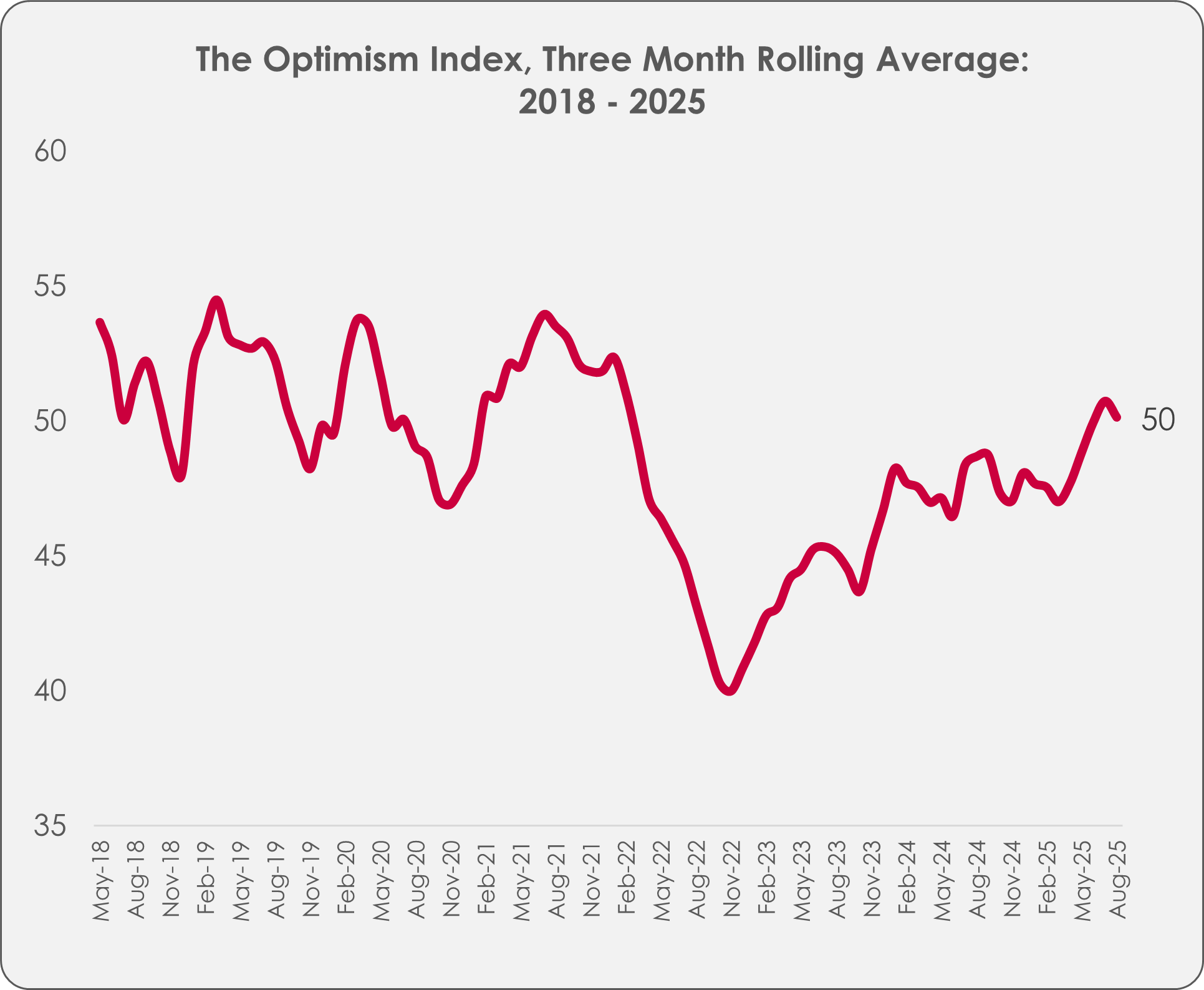
In August, optimism dipped by two points - enough to send it back into negative territory for the first time since April. The three-month average is sitting on the fence at 50.
How so?
As we’ve been monitoring optimism for many years, it is possible to discern seasonal patterns. One of these is a dip in optimism in August as the days shorten and as six weeks of school holidays takes its toll. The summer is over. Autumn may be a time of mists and mellow fruitfulness but it also marks a return to the starting line of the school run and Christmas decorations being put up in your local Harvester. No wonder we get a bit down.
There are two other factors to bear in mind - the index is only just in negative territory and it is still above where we were this time last year. Further, the polarisation of opinion across our sample influences the overall average. This month we’ve seen the most optimistic respondents (high earners and Londoners in particular) become a bit less tiggerish.
It’s been hard to miss news stories about small boats and immigration over the summer and that is reflected in our data. In terms of the issues that consumers care about most, immigration is now level with the NHS and healthcare. Older people have become much more concerned about immigration than younger people.
The full data and analysis from the Optimism Index is available to our subscribers. Details of our subscription packages are summarised at the bottom of this communique.
The States they are in
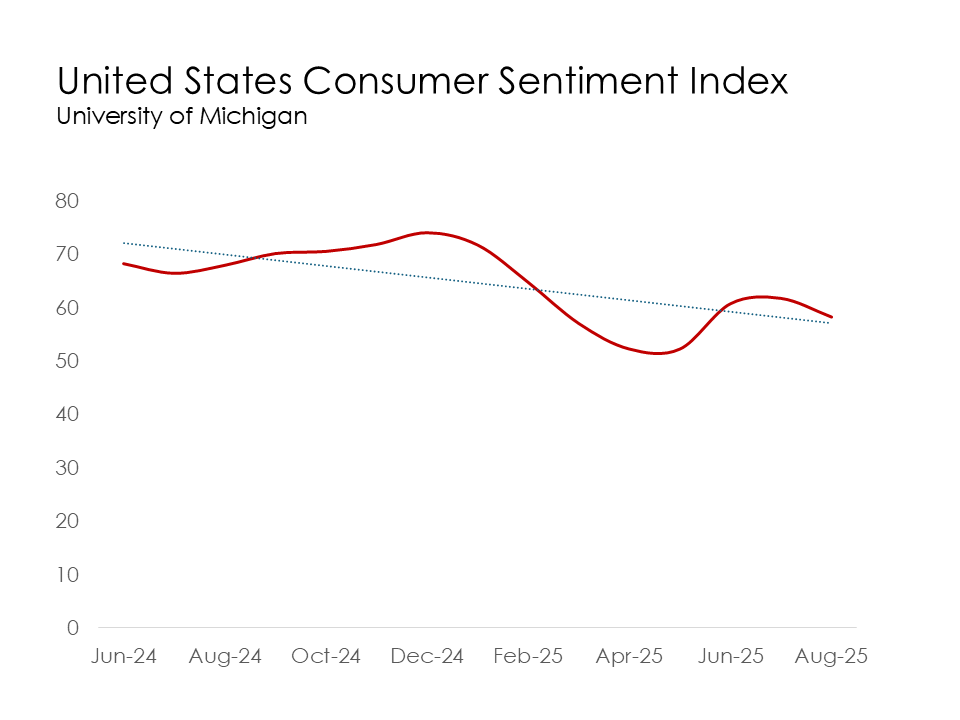
Regular readers (God bless you) may recall that I looked at American consumer sentiment in April through the horizon-scanning lens that is the University of Michigan’s Consumer Sentiment Index. Unlike our own Optimism Index, this index is based solely on perceptions of the economy and personal finances. As today marks Patsy Cline’s birthday (she was born in Winchester, Virginia), I think it is time to have another look at where American consumers are at.
Despite the idiosyncratic actions being taken to make America great again, the index is ten percentage points lower than it was a year ago. Last month the index dropped for the first time in four months. The fall in confidence is attributed to concern over rising inflation. While Americans are increasingly gloomy about their national economy, they are currently fairly neutral on the subject of their own finances. However, when asked about the future, they become less sanguine; “The share of consumers expecting unemployment to worsen in the year ahead was about 32% in 2022 and as recently as November 2024, but is now about 60%, a reading last seen in the Great Recession.”
The Michigan study is widely reported in the United States and beyond. It is often used as a barometer of the consumer mood. The media report the relative movement of the index rather than the methodological minutiae because nobody’s interested in that kind of tedious detail. Nobody apart from consumer insight people, that is. You can get the full detail here.
Are we falling out of love with the NHS?
Sometimes, we have a curious ability to reconcile two opposing views and to believe in them both.
The NHS is perhaps the best example. Most British people are proud of the concept of the NHS and want to keep it in its current form; four in five Britons think that the NHS should be funded from general taxation and 90% think it should be free at the point of use. At the same time, the British Social Attitudes survey found that the proportion of people who are satisfied with the performance of the NHS slumped to an all-time low of 21% last autumn. Satisfaction has been falling in every one of the past five years.
We love the idea of the NHS but we don’t like the reality of it.
As Nigel Lawson observed, the NHS is; “the closet thing the English have to a religion.” A devout electorate means that very few politicians can afford to be heretics. Consequently, progress towards any reformation will be difficult and slow.
At our next trend webinar, we’ll be asking if we still trust the anaemic NHS. We’ll look at the public’s appetite for alternative forms of healthcare and whether young people believe in the health service in the same way as their parents and grandparents.
The webinar takes place on September 25th at 09:00. Tom Johnson will be considering the symptoms and offering a prognosis.
Rather like the NHS, the webinar is free at the point of delivery but, unlike the NHS, you’ll have no difficulty in booking an appointment. Just press the button below.
Bittar culture war
Every month I look at real-world manifestations of Trajectory’s macro trends.
Allow me to introduce you to Margeaux. She is an old-money WASP buzzing within the confines of the champagne flute that is New York’s Upper East Side. She is described as both an emotional terrorist and an icon. She is also; “wildly inappropriate.” Margeaux is a Boomer bewildered by modern times; she struggles to wake up to the woke landscape (despite guidance from Hazel, her downtrodden PA and “downtown IT girl”).
Margeaux’s adventures are catalogued in an extensive mockumentary series - the “Bittarverse.” Both Susan Sarandon and Amy Sedaris guest star as does the “world renowned image architect to the stars”, Law Roach. Each episode is 90 seconds or less. The Bittarverse has acquired something of a cult following and from its natural home on Instagram has gathered a following of 320,000 people. Last year, the Bittarverse won a Webby award. I could explain it further but it’s way more instructive and entertaining to spend 84 seconds watching this episode. *
Welcome back.
The Bittarverse is low-fi satire that pokes fun at high fashion. The Bittarverse is also brand advertising; Alexis Bittar is a Brooklyn-based jewellery business and Margeaux is burdened by the weight of their statement pieces in each episode. The films are scripted by the brand’s eponymous founder who says of the ongoing campaign; “I always tried to use advertising to kind of push political messages within the fashion world whether it was ageism or visibility with Trans rights.” Mr Bittar is in the privileged position of not being beholden to shareholders or investors as he concedes; “I’m not driven by the dollar to build a brand. That’s not common thinking in private equity … but I don’t have to worry about that anymore.” Instead, Mr Bittar sees his business as a direct expression of his personal brand; “A brand builds community. I feel strongly about that. If I was to play it safe, I would be disinterested in the brand … So, for me, I made a conscious decision years ago that I would speak my mind and if there’s a fallout, there’s a fallout and I’m okay with that.”
More recently, Mr Bittar joined forces with the movie producer Bruce Cohen (who developed American Beauty) to make a half hour documentary; “Reclaim the Flag” which was released in July 2025. The film’s contention is that the Stars & Stripes have become co-opted by the American political right. In Mr Bittar’s view, Old Glory has come to represent a threat rather than a promise.
“It’s become such a symbol of aggression, the American flag, like ‘we’re coming for you’ during Trump’s era. How tragic this is, like this is where we’re at that the ultimate symbol of the United States, is now used as a weapon to bifurcate? The concern about Trump and Project 2025 was the impetus [for the film].” - Alexis Bittar
The documentary considers the changing meaning of the flag to all Americans and to the LGBTQIA community in particular. There has been an echo of this in England in recent weeks with the flag of St George proliferating on lampposts, motorway bridges and mini-roundabouts.

Mr Bittar is at pains to point out that Reclaim the Flag is entirely separate from his jewellery business and that it is not a promotional vehicle. However, when the business brand is an expression of the personal brand, it’s hard to disassociate the two.
Our Political Brands trend states that; “Meaningful brands need strong views to connect with consumers. Navigating polemic politics takes bravery, agility and authenticity - but doing nothing is not an option.” Mr Bittar embodies all of this.
*If you have a busy afternoon, I’d advise you to wait until after work before watching an episode. A single episode can easily become two or twenty, leading to significantly impaired executive productivity.
Subscribe to Trajectory
The world has become a more volatile place (just ask Margeaux). For that reason, it’s vital to have an up-to-date understanding of what matters to consumers. Our monthly programme of quantitative research informs our subscription service and gives you a contemporaneous and reliable analysis of the consumer mood.
An annual subscription starts at less than the price of an Alexis Bittar Solanales Crystal Spear Layered Fringe necklace. You know what I’m saying. I won’t labour the point.
Here are the options:
Now
An offline service that continually monitors the consumer pulse. Subscribers receive a monthly report, invitations to subscriber-only webinars and an analysis of consumer sentiment based upon our monthly fieldwork. £500 per year, per user.
Now & Next
The core, online, package. Access to monthly data, webinars, reports, articles and macro-trends. £3,200 per year per organisation (unlimited users).
Now & Next +
All of Now & Next plus offline humanity! We’re including analyst support in this package. There is also the ability to add your own questions to our monthly fieldwork with 1,500 nationally representative Britons. £7,500 per year per organisation (unlimited users).
 | A guest post by
|